Personal analytics 10 min
A Practical Quantified-Self System for Indie Developers
Build a small, private personal analytics system that connects health, mood, habits, work, and product signals without drowning in dashboards.
Read field noteTracking tools · Commercial investigation for an app that connects personal data and reveals useful individual patterns
Compare Swaymark, Exist, Gyroscope, Bearable, and focused trackers by data sources, questions answered, evidence limits, and daily effort.
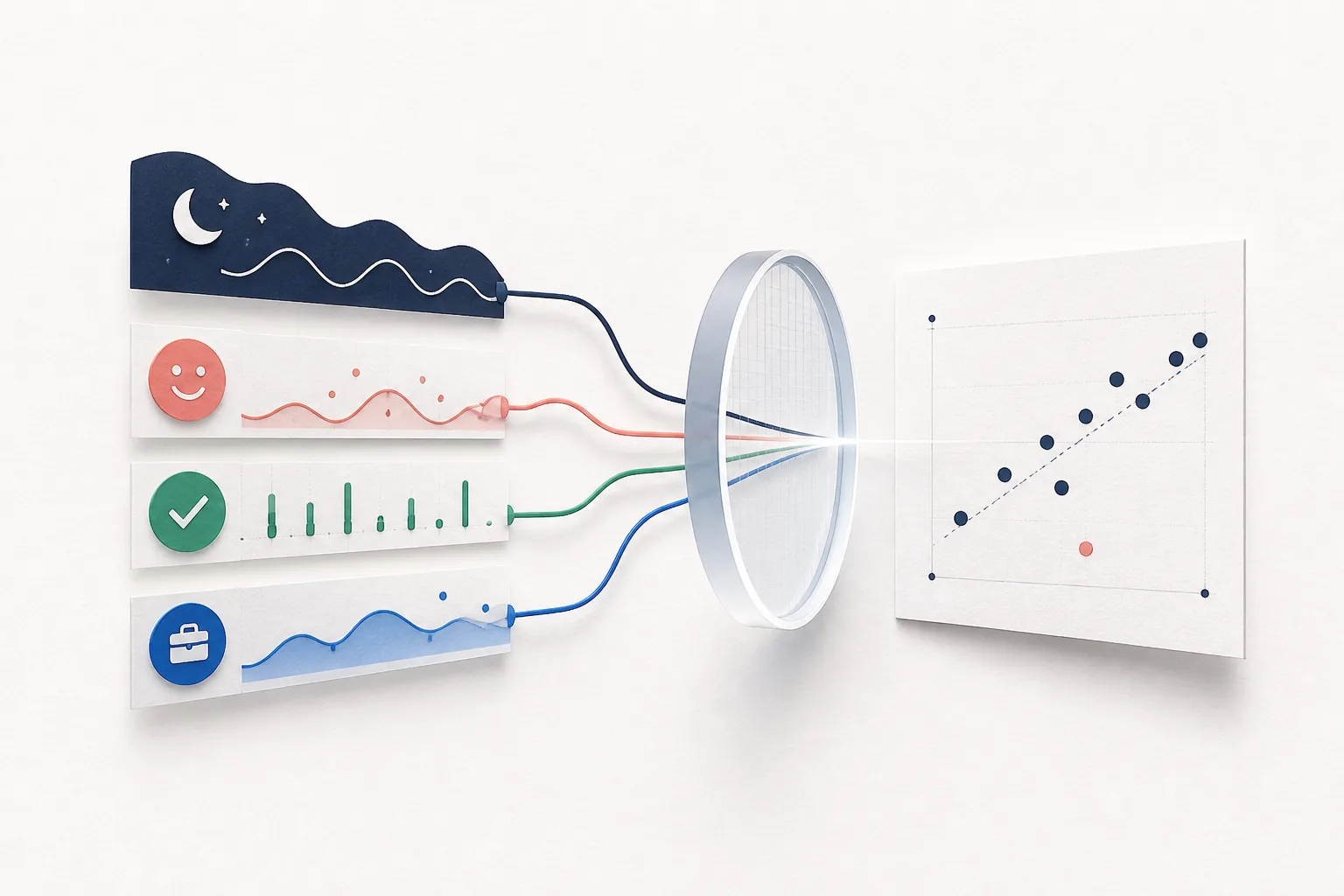
Personal analytics is useful when scattered data becomes a better decision. Sleep in one app, mood in another, commits on GitHub, and revenue in a dashboard may each be accurate while still failing to explain what made a week feel sustainable or brittle.
The category spans automatic aggregators, health journals, quantified-self timelines, and focused trackers. Compare them by the question they are built to answer, the burden of maintaining the data, and how carefully they communicate uncertainty. A longer integration list is not automatically a better personal model.
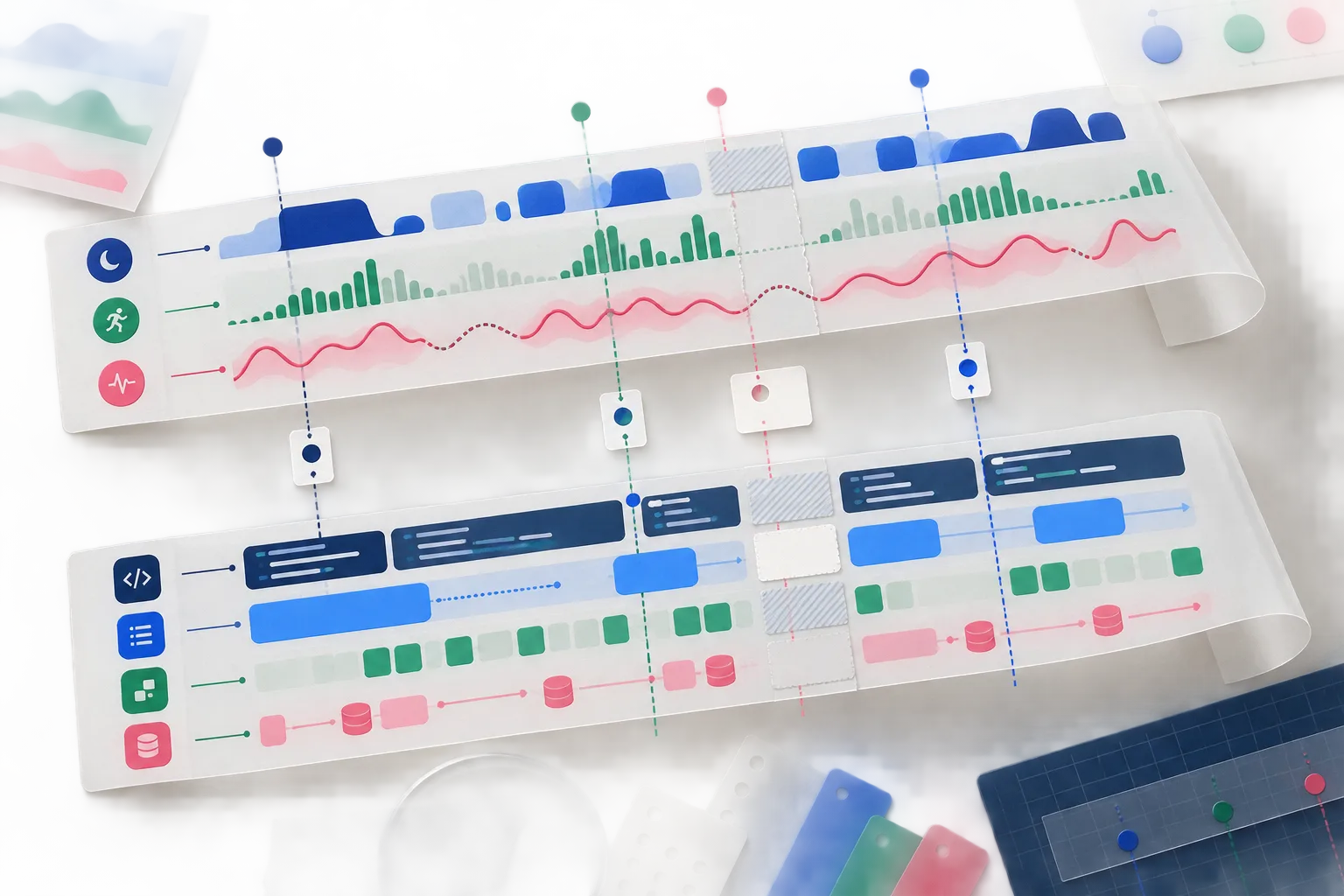
Exist combines automatic and manual data across domains and looks for correlations. Gyroscope emphasizes a broad health and lifestyle view, including sleep, food, mood, productivity, and coaching features. Bearable is a configurable health and symptom tracker. Swaymark focuses on recovery, mood, habits, and work or product output on the same timeline.1345
| Tool | Primary job | Notable inputs | Best fit |
|---|---|---|---|
| Exist | Cross-domain correlations | Automatic integrations plus manual tags | People who value breadth and automation |
| Gyroscope | Health and lifestyle timeline | Health, food, mood, sleep, and productivity | People wanting a rich life dashboard |
| Bearable | Symptoms and factors | Custom symptoms, mood, medication, and health | People investigating health factors |
| Swaymark | Personal context beside work | Apple Health, mood, habits, GitHub, and product signals | Indie developers and knowledge workers |
Exist is compelling when you want many sources brought together with little manual work, then summarized through trends, correlations, experiments, and weekly views. Its public values also emphasize export, API access, and user control. Gyroscope may be the better fit for someone who wants an expansive personal health interface and optional coaching in one system.123
Swaymark deliberately connects a narrower personal observability loop to work. GitHub contributions are observable events with specific counting and timestamp rules, not a complete measure of creative output. Product signals can add context, but a thoughtful design session, private repository work, or difficult support conversation may remain invisible.56
A sleep duration imported from a wearable, a 1 to 10 mood check-in, a manually completed habit, and a proprietary readiness score are different kinds of evidence. A score may summarize several inputs, but it should not be treated as a direct measurement of today's ability to do knowledge work.
Prefer tools that preserve those distinctions and keep missing data missing. Useful analysis names the window, sample size, timing, and exceptions. If an app reports a strong association from a small or selective sample, treat it as a hypothesis worth testing rather than a personal law.
The most useful output is often a small experiment: stop coding an hour earlier for one week, move a workout away from launch day, or protect a focus block after nights with sufficient sleep. Review the outcome against your own baseline and record the counterexamples.
If the tool never changes a decision, simplify. Remove unused integrations, reduce manual fields, or switch to a focused tracker. Personal analytics should create a calmer review loop, not another system that demands perfect compliance.
Put it into practice
Plain answers
It is a tool that organizes data about your own behavior, health, mood, environment, or output so you can inspect patterns and make decisions. The best tools communicate uncertainty clearly.
No. Personal time-series data can reveal associations and useful hypotheses, but confounding events, reverse direction, missing data, and small samples limit causal claims.
Automatic tracking reduces effort for observable events. Manual check-ins capture subjective context machines cannot know. A useful system often combines both while labeling them clearly.
Swaymark is designed for indie developers who want health, mood, habits, GitHub, and optional product signals across the same dates. Exist may suit someone prioritizing broader general integrations.
Weekly review can catch data problems and memorable context. Stronger pattern claims need enough repeated observations, representative periods, and counterexamples. There is no universal minimum for every question.
Build a small, private personal analytics system that connects health, mood, habits, work, and product signals without drowning in dashboards.
Read field noteA privacy-aware method for aligning Apple Health sleep, activity, and recovery context with GitHub activity, focus, mood, and meaningful work outcomes.
Read field noteLearn how sleep, HRV, resting heart rate, mood, and fatigue can add useful context to work output without turning a recovery score into a verdict.
Read field note