Recovery and work 9 min
HRV and Productivity: A Careful Guide to Personal Patterns
Understand what wearable HRV can and cannot say about productivity, then compare it with meaningful work outcomes using a personal baseline.
Read field noteRecovery and work · Understand how recovery signals relate to knowledge work and build a careful personal comparison.
Learn how sleep, HRV, resting heart rate, mood, and fatigue can add useful context to work output without turning a recovery score into a verdict.
A recovery score can feel authoritative at 7 a.m., especially when a demanding day is already waiting. The useful question is not whether the score permits you to work. It is whether several recovery signals add context to the kind of work you can do sustainably today.
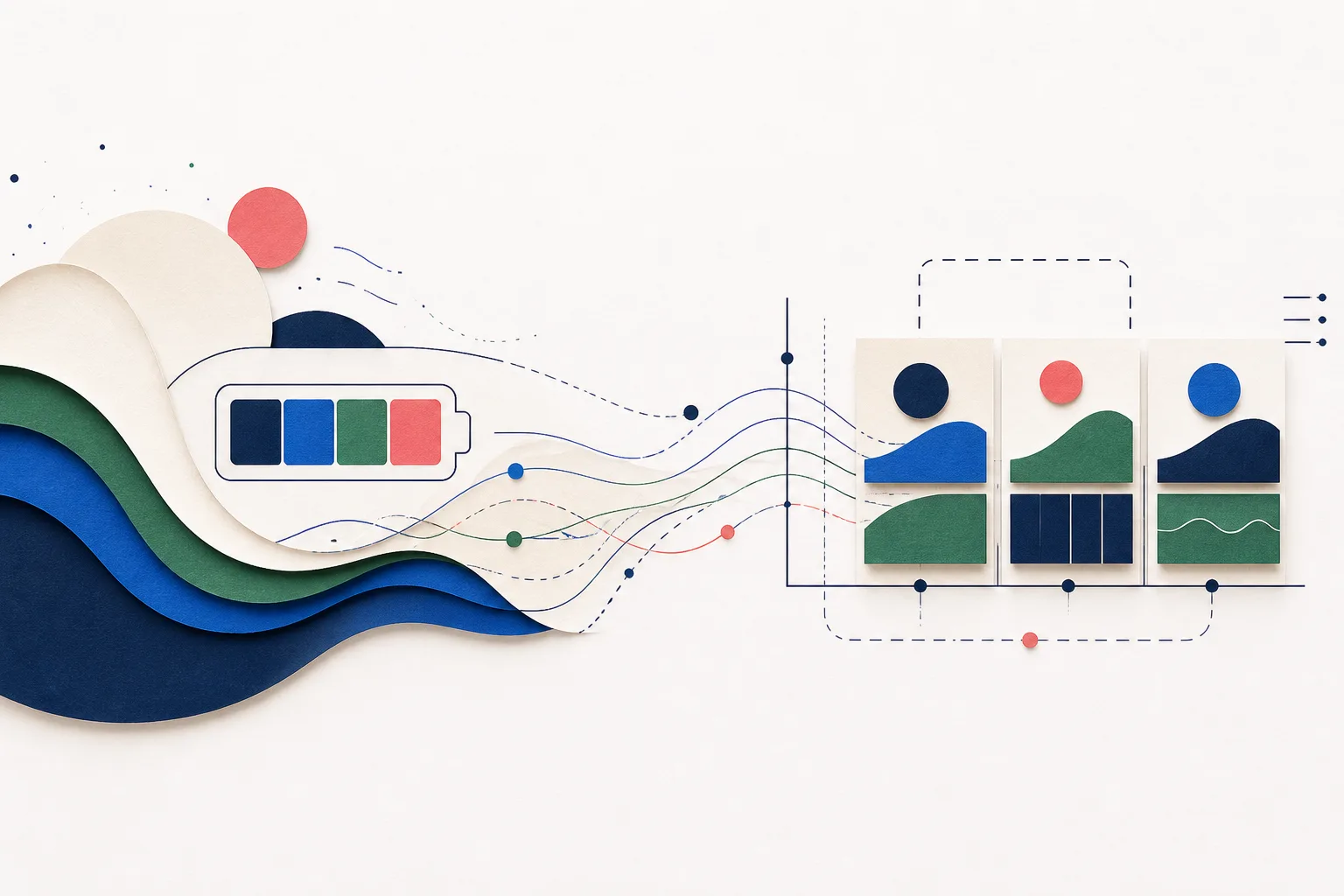
Swaymark puts personal and work signals on the same timeline so you can inspect what moved together. That comparison is personal observation, not a diagnosis or proof of causation. It becomes more useful when you keep the raw signals separate, choose a work outcome that matters, and preserve the days that contradict your first theory.
Recovery is not one directly measured quantity. Sleep duration, resting heart rate, and some HRV readings are measurements. Fatigue and mood are self-reports. A wearable readiness or recovery score is a proprietary summary derived from several inputs. WHOOP and Oura document different contributors and interpretation rules, which is why scores from two systems are not interchangeable.12
Keep those layers visible. A low composite score may be worth noticing, but it should not erase how you feel, an unusual travel day, a hard workout, illness, medication changes, or measurement gaps. Your own consistent baseline is generally a more useful comparison than another person's number.3
| Signal | What it is | Useful interpretation | Important limit |
|---|---|---|---|
| Sleep duration | Measured or estimated | How much sleep was recorded | Duration does not capture every aspect of sleep |
| HRV and resting heart rate | Measured, then processed | Change from a consistent personal baseline | Device, timing, posture, and context matter |
| Mood and fatigue | Self-reported | How the day felt to you | Memory and check-in timing can shift ratings |
| Readiness or recovery score | Proprietary derived score | A vendor's summary of selected inputs | The formula and meaning vary by product |
Fatigue can affect attention, memory, reaction time, and judgment. Sleep research also finds relationships between sleep and work outcomes, including performance and affect. These findings make recovery a plausible source of context for knowledge work, but population evidence does not tell you exactly how one morning's score will affect one pull request or sales call.45
The work measure matters. GitHub contributions can show dated contribution activity, but they do not measure code quality, planning, customer conversations, or the difficulty of a problem. A useful personal view might pair contribution activity with a short focus rating and one concrete daily outcome, such as whether the day's most important task reached a defined finish line.6
Start with a window long enough to contain ordinary variation, usually several weeks rather than a few memorable days. Define the timing before looking at results. For example, compare last night's sleep and morning recovery signals with that day's work, not with an undefined mix of past and future outcomes.
Split days around your own baseline only after you have enough observations. Compare medians, the size of each group, missing days, and counterexamples. Then add obvious context such as weekends, travel, illness, launches, or late-night work. If the difference disappears when launch week is removed, that is useful information rather than a failed analysis.3
Suppose lower sleep and lower morning HRV often coincide with a lower focus rating, but some of your strongest output still happens on those days. A reasonable experiment is not to cancel difficult work whenever HRV falls. It might be to protect an earlier focus block, reduce late-night coding for two weeks, and compare the same outcomes again.
Choose a change you can actually sustain and a review date. Keep other major routine changes limited where practical. The result may be no clear difference, and that is valid. Personal data is most useful when it narrows uncertainty instead of manufacturing certainty.
A tracker cannot diagnose the cause of persistent fatigue, significant sleep problems, marked mood changes, chest symptoms, fainting, or concerning heart readings. Seek qualified medical care for persistent or clinically important concerns. Do not delay care while waiting for a cleaner personal dataset.
On ordinary variable days, recovery signals can still support a humane planning habit. They can suggest when to protect attention, choose a smaller experiment, or notice that an apparently unproductive day followed an unusually demanding week. They should not become another reason to punish yourself.
Put it into practice
Plain answers
Not automatically. A proprietary score is one piece of context, not permission or a forecast. Consider how you feel, the task, safety, recent trends, and your own repeated patterns.
There is no universal best signal. Sleep, fatigue, mood, HRV, and resting heart rate describe different things. Begin with sleep plus a brief self-report, then add device signals only if they improve decisions.
Several weeks is a practical starting point, but the needed sample depends on how often the condition and outcome occur. Always show the actual count and avoid conclusions from a handful of unusual days.
No. Swaymark helps you compare dated signals, samples, and exceptions. It can surface an association worth testing, but observational personal data cannot by itself prove causation.
No. Wearable and self-reported recovery signals are context, not a diagnosis. Bring persistent or concerning symptoms and values to a qualified health professional.
Understand what wearable HRV can and cannot say about productivity, then compare it with meaningful work outcomes using a personal baseline.
Read field noteA practical, evidence-led guide to comparing sleep duration and consistency with focus, output, mood, and sustainable work.
Read field noteCompare apps that use Apple Health context for habits, mood, personal analytics, and sustainable work without treating health scores as productivity grades.
Read field note