Tracking tools 11 min
The Best Mood Tracker Apps for Check-Ins, Journaling, and Patterns
Compare Daylio, How We Feel, Apple Health, Bearable, and Swaymark by logging style, privacy model, health context, and intended use.
Read field noteComparisons · Commercial comparison between cross-signal work analytics and configurable symptom and health tracking
Compare Swaymark and Bearable by primary use case, inputs, health integrations, experiments, work context, and who should choose each.

Swaymark and Bearable both help people compare factors across time, but their centers of gravity are different. Bearable starts with symptoms and health context. Swaymark starts with the shape of a person's days and adds observable work or product signals for careful reflection.12
This is not a clinical comparison and neither product should be treated as a diagnostic system. The right choice depends on whether your recurring question is primarily about symptoms and treatment context or about the relationship between recovery and knowledge work.
Bearable describes customizable tracking for symptoms, mood, medications, health measurements, factors, reports, and experiments. Swaymark records five daily signals and mood, imports selected Apple Health context, and connects GitHub plus optional product-business sources.12
| Area | Bearable | Swaymark |
|---|---|---|
| Primary job | Symptom and health factor tracking | Personal context and work analysis |
| Manual inputs | Symptoms, mood, medication, factors, and more | Five daily signals, 1 to 10 mood, and optional notes |
| External context | Health integrations | Apple Health, GitHub, and optional product signals |
| Outputs | Reports, insights, and experiments | Trends, comparisons, turning points, weekly story, and experiments |
| Best fit | People managing complex health context | Indie developers and knowledge workers |
Bearable's official feature set is built for detailed customization. Users can track symptoms, mood, energy, sleep, medications, and factors, then create reports and explore experiments. That depth is a real advantage when a person needs a structured record of how symptoms and interventions varied over time.1
If you plan to bring reports to a clinician, check the current export and sharing format with that clinician first. A detailed app history can support recall, but it does not establish a diagnosis or show that a factor caused a symptom change.
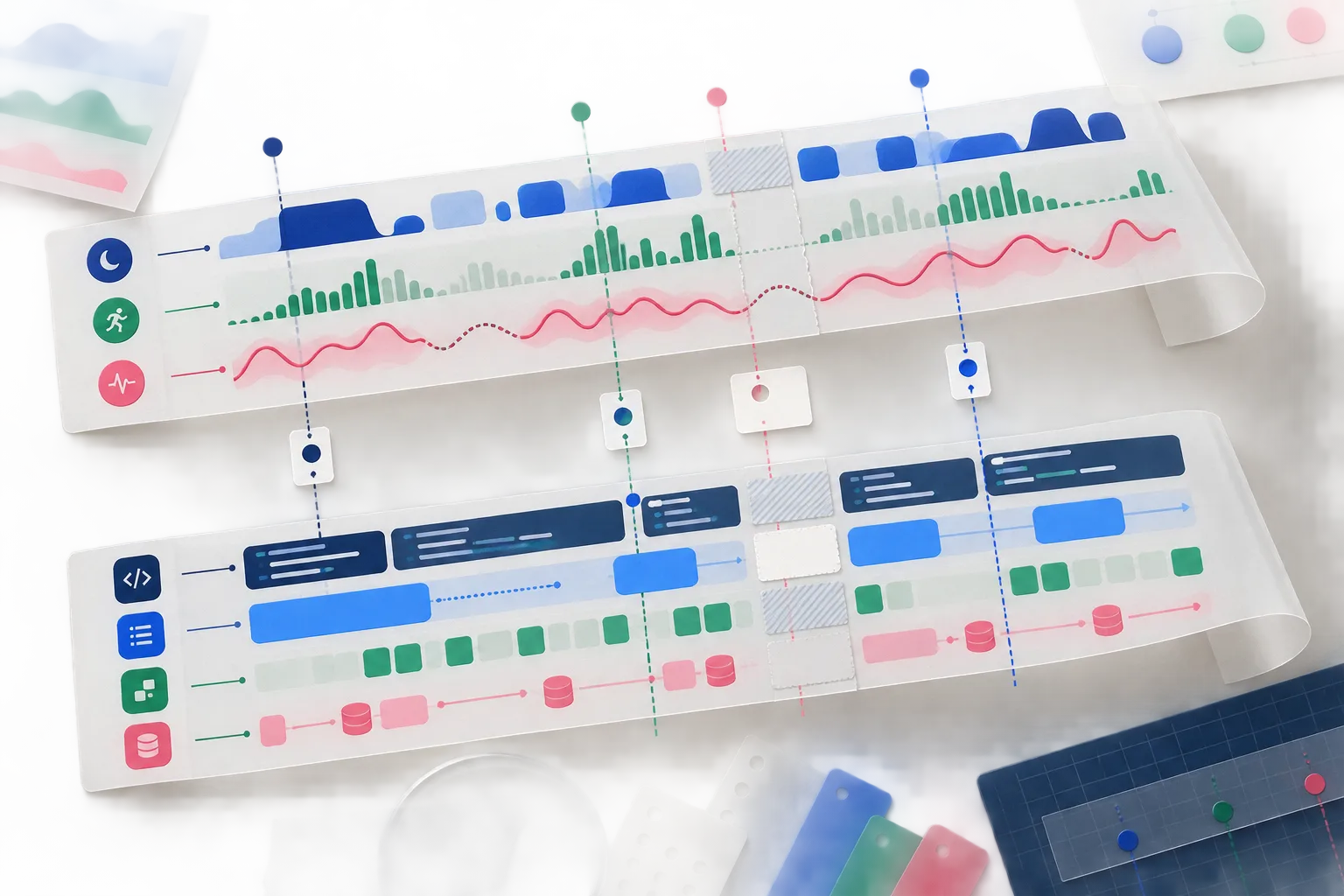
Swaymark is designed for questions such as whether late release work, short sleep, low mood, and GitHub activity tended to cluster in the same periods. Optional PostHog, RevenueCat, Stripe, and X connections can add product pressure or outcome context for an indie developer who otherwise keeps those signals in separate dashboards.24
Work signals need careful interpretation. GitHub documents specific rules for which events count as contributions and how they appear. A quiet contribution graph may hide design, research, support, private work, or a hard problem that produced little visible output. Swaymark should support reflection, not worker surveillance or self-punishment.4
Bearable's flexibility can require more configuration and manual detail, which is worthwhile when those fields matter. Swaymark keeps its daily signal set deliberately small, then relies on selected integrations for context. Choose the system whose missing entries and difficult days remain honest rather than pushing you toward false completeness.12
Swaymark says Apple Health access is permissioned and read-only for requested categories, connected sources can be revoked, and account-scoped application data is stored in its service. Review Bearable's current policy and plan terms directly before purchase because health-app practices and prices can change.31
Put it into practice
Plain answers
Bearable is primarily positioned as a symptom, mood, and health tracker. Factors can include activities, but work and product signals are not its central public use case.
No. Swaymark includes health and mood context but is not designed as a clinical symptom, medication, or treatment diary. Choose a focused health tracker when those needs are central.
No. Both can help reveal patterns and support experiments, but personal observational data includes confounders, missing values, and possible reverse direction.
Bearable is more aligned with symptom and health reporting. Confirm its current report format with your clinician. Swaymark is not a clinical record or medical-care product.
Swaymark is more directly designed for indie developers because it can connect recovery and mood with GitHub and optional product-business signals.
Compare Daylio, How We Feel, Apple Health, Bearable, and Swaymark by logging style, privacy model, health context, and intended use.
Read field noteA privacy-aware method for aligning Apple Health sleep, activity, and recovery context with GitHub activity, focus, mood, and meaningful work outcomes.
Read field noteCompare Swaymark and Daylio by mood logging, habit context, health and work connections, privacy model, and the questions each app answers best.
Read field note