Tracking tools 11 min
The Best Personal Analytics Apps for Understanding Your Own Patterns
Compare Swaymark, Exist, Gyroscope, Bearable, and focused trackers by data sources, questions answered, evidence limits, and daily effort.
Read field noteComparisons · Commercial comparison between two personal analytics tools with different audiences and integration strategies
Compare Swaymark and Exist by integrations, manual tracking, correlations, experiments, work context, privacy posture, and audience.

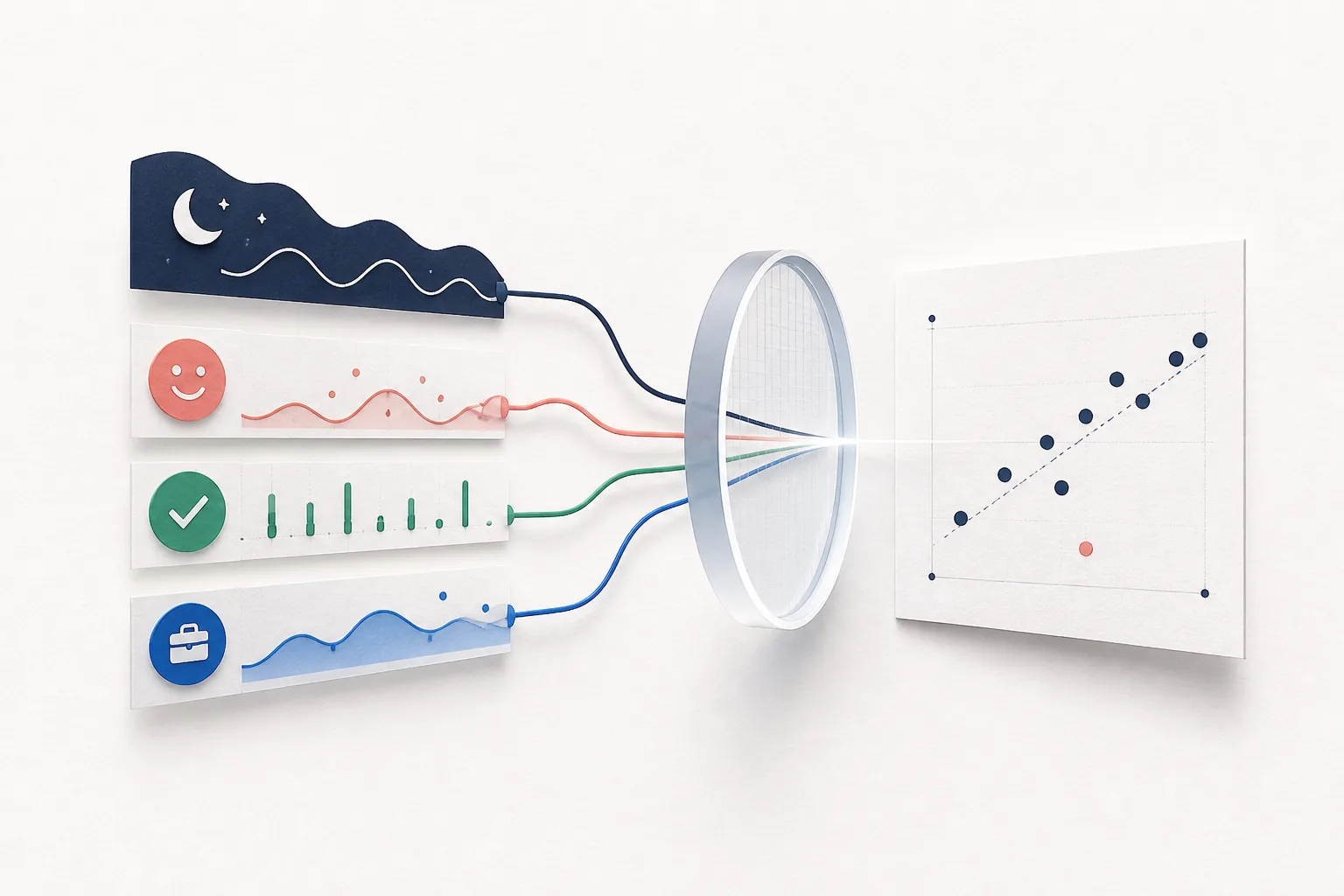
Exist and Swaymark share a useful premise: a signal becomes more informative when it can be compared with the rest of a person's life. Both support manual and connected context, patterns, and experiments. Their clearest difference is scope and intended audience.13
Exist is a broad personal analytics service with many kinds of integrations and user-defined tracking. Swaymark is a more focused personal observability product for indie developers and knowledge workers. This comparison relies on official product information and does not invent hands-on results.13
Exist describes automatic tracking, custom tags, cross-domain correlations, trends, experiments, and weekly summaries. Swaymark records five daily signals and mood, adds permissioned Apple Health context, and can connect GitHub plus optional product-business sources before suggesting a bounded experiment.13
| Area | Exist | Swaymark |
|---|---|---|
| Primary job | Broad personal analytics | Health and work reflection |
| Manual tracking | Custom tags and attributes | Five named signals, mood, and notes |
| Connected context | Broad automatic integrations | Apple Health, GitHub, and selected product tools |
| Outputs | Correlations, trends, summaries, and experiments | Comparisons, turning points, weekly story, and playbook |
| Best fit | Quantified-self generalists | Indie developers and knowledge workers |
Exist's strongest case is its broad personal analytics model. Its official materials describe automatic data sources, manually tracked attributes and tags, correlations across categories, experiments, trends, and weekly summaries. That flexibility suits someone whose questions shift across fitness, sleep, mood, productivity, weather, and other domains.1
Exist's published values also make data export, API access, scoped integration permissions, and a single-plan business model part of the product philosophy. People building their own workflows or prioritizing data portability should examine those current capabilities closely.2
Swaymark narrows the problem around how a week felt and what moved with observable work. Its five daily signals cover Sleep, Move, Focus, Side project, and Nutrition. Mood check-ins, selected Apple Health imports, GitHub history, and optional PostHog, RevenueCat, Stripe, and X signals add context without requiring every connection.3
The intended output is a cautious weekly story, a small experiment, and useful observations saved to a Personal Playbook. That opinionated loop may be more approachable for an indie developer than a highly customizable analytics system. It is less suitable when you want the broadest possible integration catalog or custom attribute model.3
A correlation can surface a question, but it cannot establish why two signals moved together. The direction may be reversed, a third event may affect both, or the sample may overrepresent unusual weeks. Automatic data can also have device gaps, while manual entries may disappear precisely when life becomes difficult.
Prefer a narrow window and a reversible test. Record the hypothesis before changing anything, keep missing data missing, and look for counterexamples. Health and recovery outputs are context rather than medical advice. Seek professional care for persistent or concerning symptoms.
Put it into practice
Plain answers
Both are personal analytics products, but Exist is broader and more customizable. Swaymark has a tighter focus on recovery, mood, habits, and work or product context.
Exist publicly positions itself around a broad range of automatic integrations. Swaymark supports a selected set aimed at Apple Health and indie product work.
Exist makes export and API access explicit parts of its public values. Verify the current formats and plan details against your exact workflow before choosing.
Swaymark is designed to connect GitHub with optional PostHog, RevenueCat, Stripe, and X context. No single work signal represents complete productivity.
No. Both can help identify associations. Establishing cause requires stronger designs, and personal data often contains missing observations, confounders, and exceptions.
Compare Swaymark, Exist, Gyroscope, Bearable, and focused trackers by data sources, questions answered, evidence limits, and daily effort.
Read field noteBuild a small, private personal analytics system that connects health, mood, habits, work, and product signals without drowning in dashboards.
Read field noteCompare Swaymark and Gyroscope by health and lifestyle scope, work context, coaching, tracking effort, audience, and evidence limits.
Read field note